Customer Success
Select Engagement Summaries
Top 5 global biopharma
7+
YEARS
of collaboration
Developing across multiple therapeutic modalities
Small molecules
Antibodies
ADCs
Peptides
LNPs
Enzymes
Transformation of drug substance, formulation, delivery system and bioprocess development processes
with wet-lab validated AI models
Selected success stories
20x
Enhancement in biocatalytic activity
For a complex reaction involving racemic mixtures.
16x
Higher hit-rate in catalyst & reagent selection
For cross-coupling reactions.
20%
Downstream yield improvement
Using an AI digital twin for mAb synthesis.
Leader in genomics medicine for rare diseases
6+
YEARS
of collaboration
Across the R&D value chain
Disease studies
Target identification
Therapeutic & delivery-system design
CMC
Preclinical & clinical testing
QC
TechOps
Significant contribution to successes in
Peptides
Enzyme replacement therapies
AAV based gene therapies
ASOs
Through Biobank-scale Genomics, Multi-omics, Generative and Multi-modal AI
Selected success stories
FDA trial pause lifted
Rapid resolution of a clinical trial pause
Demonstrated that tumors observed in animal models were unlikely to have resulted from host-vector fusion.
Indication expansion
Expanded use of a blockbuster therapy
Supported by extensive genomic and structural biology modeling.
Top 15 global biopharma
4+
YEARS
of collaboration
Focus areas
Patient stratification
Indication expansion
Formulation optimization
Aganitha DISTILL powered transcriptomic and proteomic signature identification
from pre-clinical and clinical datasets in auto-immune disorders.
Selected success stories
Lower-dose efficacy
Efficacy demonstrated at a lower dose
Preclinical and clinical validation of a reformulated therapeutic, addressing supply constraints.
Mouse → Human
Translatable biomarkers identified
From mouse models to humans in multiple auto-immune disorders.
Select Wet Lab Confirmations
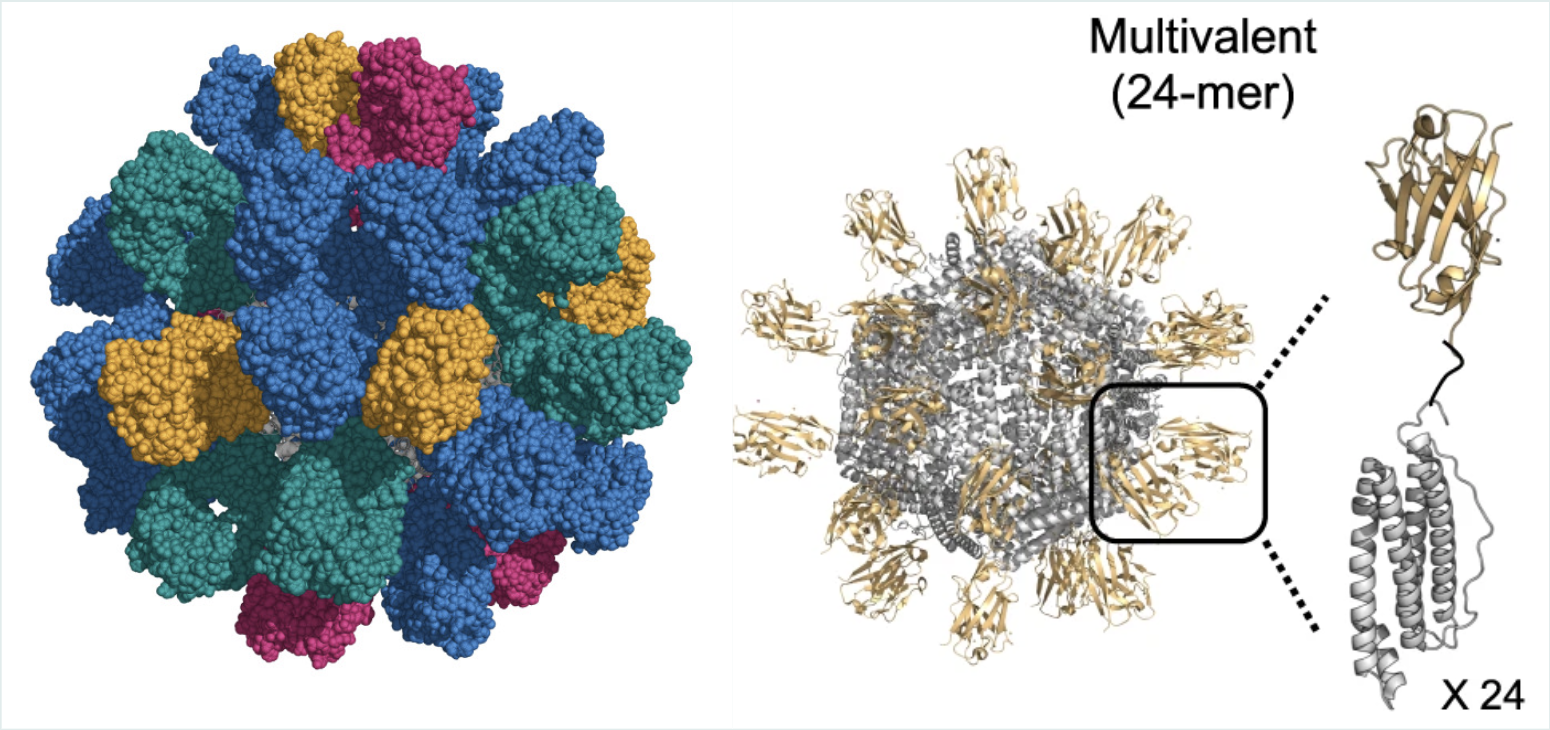
Fab screening for self-assembly in a multi-valent Tx targeting HIV
Screening for:
- Expressibility, Aggregation, Polydispersity & yield
- PK: Cmax at 24, 72 and 168h
- Recovery after 3x freeze-thaw
16x hit rate in catalyst & reagent selection
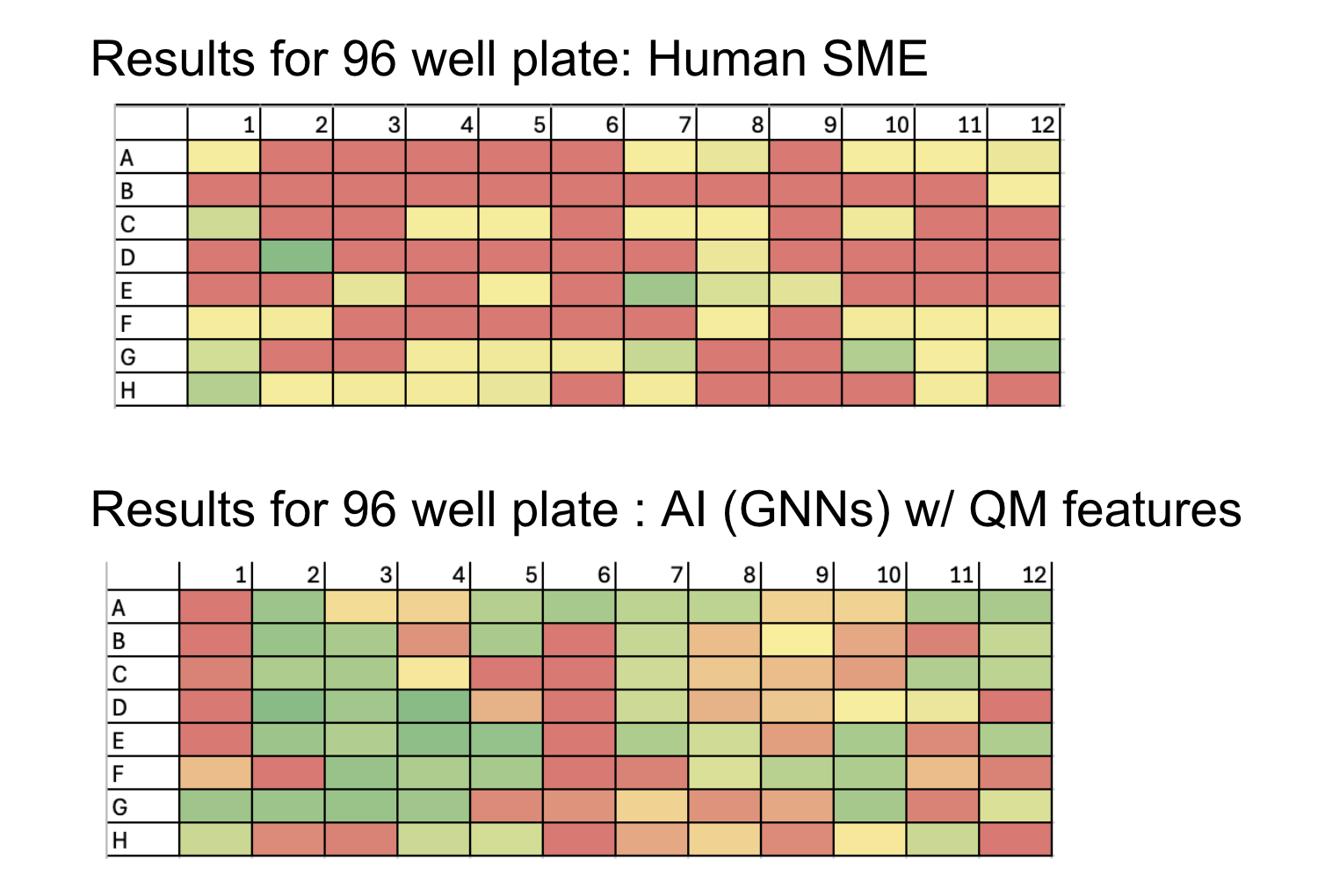
20x enzyme activity enhancement
Keto Reductase optimization in the presence of NADPH, enhancing Diastereomeric ratio, Enantiomeric excess & Conversion
- 250 single mutation data from Round 1
- Attention over pLM embedding for predictive modeling
- RL to explore optimal design
- MD to analyze the optimal interactions
Select Target & Biomarker Identification Case Studies
BI-SPECIFIC ANTIBODIES · AUTO-IMMUNE
Target ID & indication expansion for bi-specifics in autoimmune disease
Modalities
Bi-specific antibodies · multi-omics · cross-study integration
Nomination
scRNA-seq + bulk RNA-seq + cross-study metaanalysis confirmed Th2/Th22-axis dominance in lesional tissue. Ranked targets via 6-dimensional scoring with DBTIPS™ + DISTILL™.
Pathway
Receptor–ligand co-expression in Th2/Th22 axis; upstream vs downstream cytokine positioning.
Druggability
Filtered for antibody-feasible membrane/secreted proteins; epitope feasibility modeling.
Outcome : 5 prioritized targets (combined scores 5.0–6.0) with multi-indication potential for bi-specific antibody
PROTEOGENOMIC RISK · CHRONIC KIDNEY DISEASE
Plasma protein-based risk scoring for CKD prediction (Large Biobank Pharma Proteomics)
Modalities
Plasma proteomics (UKB-PPP, Olink) · pQTL genomics · clinical markers · UK Biobank
Causal Triangulation
Variants + pQTL + clinical covariates → Mendelian randomization for causal-protein identification.
Panel Selection
AI regression with stability selection across 200 bootstraps; Cox survival modeling for time-to-event.
Network
Proteogenomic network analysis linking variants to protein effects via multi-task learning.
Outcome : protein plasma panel · AUC 0.84 · outperforms clinical baseline (AUC 0.81) · CKD risk stratification
Select CMC & Manufacturing Case Studies
mAb bioprocess · Biologics manufacturing
Final-day mAb titer forecast

Digital twins of the seed train, the N-2 and N-1 seed bioreactors and the production bioreactor to forecast the final-day titer.
Methods
LSTM time-series models · sequence multi-output forecasting · A/B comparison analytics on select batches
Challenge
At a large biopharma’s mAb manufacturing site, run-to-run titer variability forced challenges in operational planning. Sometimes a low titer batch had to be dumped while on a few occasions a high titer batch required last-minute modifications to polishing operations.
Approach
A deep-learning twin of the seed train, N-2, N-1 and production bioreactors, trained on 148 historical runs of cell density, pH, pO2, pCO2, viability, glucose, lactate and phase durations. Custom analytics compared high- and low-titer runs to identify the drivers behind mAb titer outputs.
Evidence
Client engagement. The forecasting model and the analytics tool were deployed for the site’s operations team.
Outcome: Final-day titer forecast within ±1σ for 84% of runs from seed-train data alone, giving about two weeks of lead time
Drug product · Formulation
API–excipient–polymer modeling for Amorphous Solid Dispersions (ASDs)
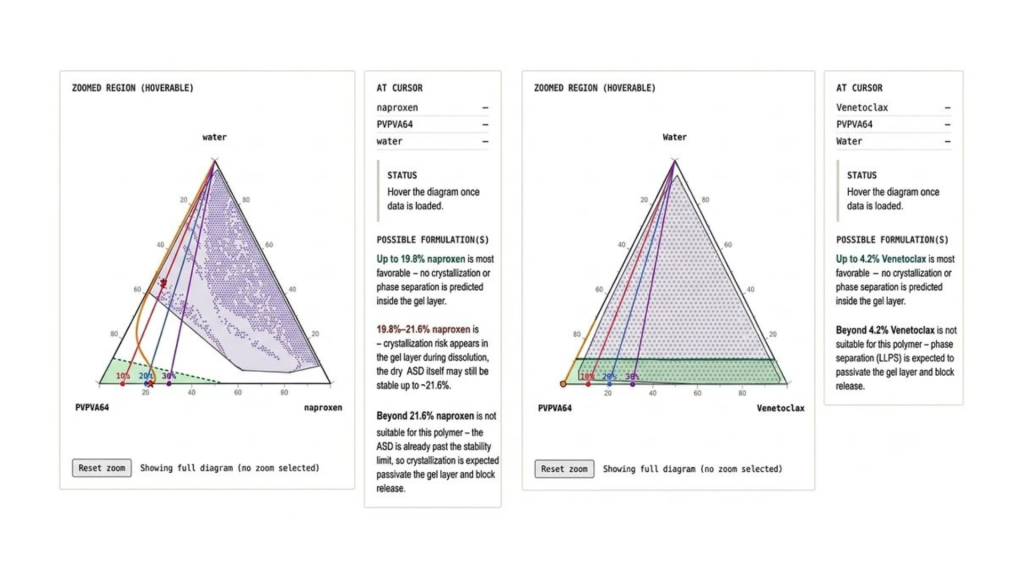
Ternary phase diagrams for naproxen (left) and venetoclax (right) with PVPVA64 and water, and the favorable drug-load range for each.
Methods
PC-SAFT thermodynamics · Atomistic molecular dynamics · Siamese networks
Challenge
An amorphous solid dispersion that carries too much drug can crystallize or phase-separate during dissolution and block drug release. Finding a safe drug load and compatible excipients usually takes rounds of formulation batches.
Approach
PC-SAFT phase diagrams, supported by MD of API–polymer systems, give the stable drug-load window before a batch is made. SiDEx-IP predicts whether an API and an excipient are compatible.
Evidence
Benchmarked on published data, with an interactive app for drug-load screening. In PVPVA64, the predicted limits were 19.8% for naproxen and 4.2% for venetoclax, consistent with published experiments. Trained on 3,594 drug–excipient pairs from the publicly available DE-INTERACT dataset, SiDEx-IP scores F1 0.92 and ROC-AUC 0.93, and was checked on ~300 further pairs for an Out of Sample (OOS) validation.
Outcome: Drug-load windows and excipient shortlists for a new API before the first formulation batch
Drug product · Excipient selection
API surrogate search: Formulation starting points for a novel API
Result: Deployed for a client’s formulation team: finds the approved drugs most similar to a novel API and the excipients their formulations used.
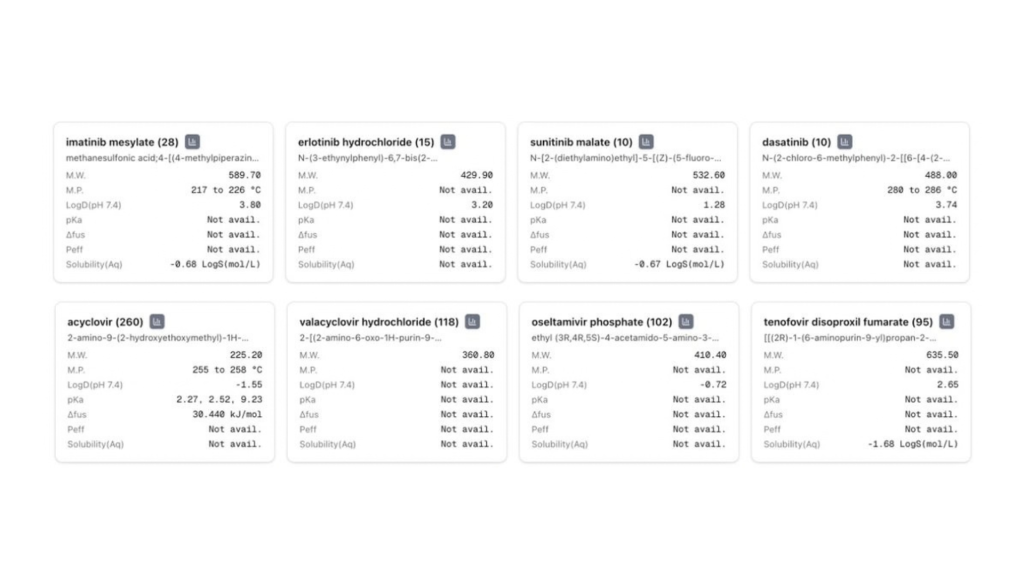
Portal results: Approved APIs with their published physicochemical properties and approved formulation details, as starting points for a new API.
Methods
Structure and property-based cheminformatics search · FDA formulation records · Data mining using Agentic AI
Challenge
A novel API has no formulation history, so the first excipients are often chosen by analogy and expertise.
Approach
The portal collates physicochemical data for ~3K approved APIs, such as melting point, pKa, logD and solubility, along with their inactive ingredients of ~150K FDA-approved formulations. Scientists can search by name, SMILES, structure or a property profile.
Evidence
Client engagement. The surrogate search model was deployed for a client’s formulation team in Europe.
Outcome: The approved drugs most similar to a novel API, and the excipients their formulations used, as starting points
Impurity control · Regulatory CMC · Toxicity
NitroSafeAI: Nitrosation risk screening for APIs and excipients
Result: A ready-to-deploy tool that flags which nitrogen atoms in an API or excipient can form a nitrosamine, validated on a public benchmark.
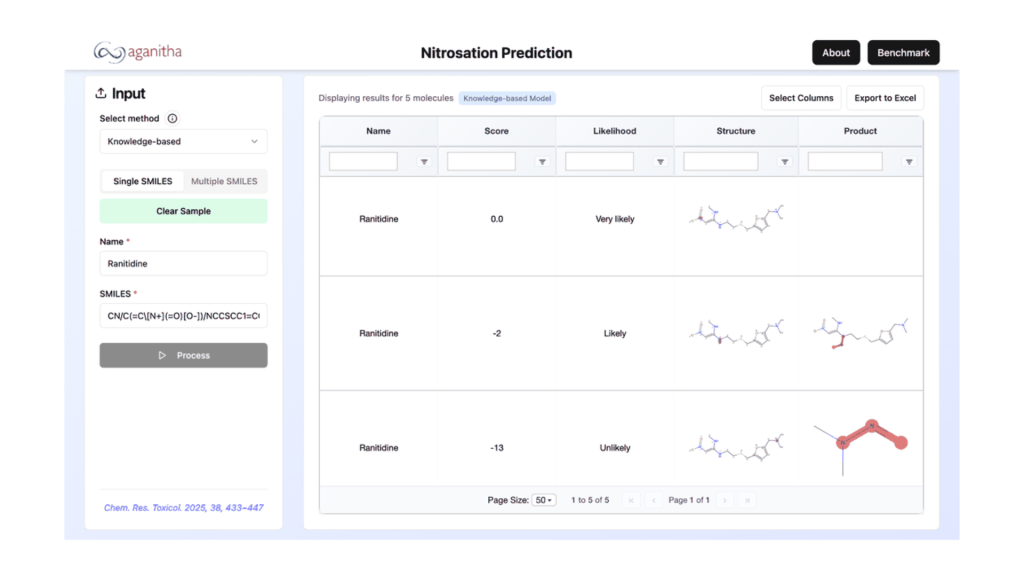
NitroSafeAI’s knowledge-based & Deep-learning based scoring of ranitidine: a score and likelihood for each nitrogen, with the possible nitrosated product identified.
Methods
Knowledge-based scoring with 3 activating and 12 deactivating features · Graph Attention Network
Challenge
Nitrosamine impurities led to recalls and withdrawals of drugs including valsartan, ranitidine and varenicline, and FDA guidance for manufacturers is to assess nitrosamine risk in their products.
Approach
NitroSafeAI scores each nitrogen atom two ways: rules that encode known nitrosation chemistry, and a graph network trained on measured nitrosation yields.
Evidence
84% accuracy on a public benchmark of 437 nitrogen atoms in 207 molecules (Reiss et al., Chem. Res. Toxicol. 2025).
Outcome: A ready-to-deploy in silico tool that flags which nitrogen atoms in an API or excipient can form a nitrosamine
Small molecule · Physico-chemical properties
Site-specific pKa in water and 34 organic solvents
Result: pKa for each ionizable site across solvents used widely in the industry, to guide salt, co-crystal and crystallization-solvent choices

SitepKa output for one molecule in DMSO: A predicted pKa for each ionizable site. 2 of its 3 ionizable sites are shown.
Methods
Dual-graph neural network · solute–solvent cross-attention · Kamlet–Taft solvent descriptors · DFT
Challenge
Process chemists work in organic solvents, but most deep-learning pKa models predict only in water, or give one value per molecule instead of one per site. Physics-based methods handle other solvents but are slow for large molecules.
Approach
SitepKa predicts a pKa for every ionizable site. Trained on 33,269 experimental values from ~10 public sources mined using Aganitha’s data curation agents.
Evidence
Preprint: SitepKa, ChemRxiv, May 2026, presented at ACS Fall 2026. Mean absolute error is 1.49–2.30 on the SAMPL6–8 aqueous blind challenges. For large molecules in 9 non-aqueous solvents, a DFT protocol with Aganitha’s in-house solvent-specific conformer generation pipeline, achieved an MAE of 2.23 on 52 validation molecules, ~100× faster than gold-standard physics protocols.
Outcome: pKa for each ionizable site across solvents used widely in the industry, to guide salt, co-crystal and crystallization-solvent choices
Small molecule · Solid-form de-risking
Polymorph, co-crystal and salt screening
Result: Recovered every reported polymorph of a marketed drug in silico, and flagged most known co-crystals in a published dataset.

Axitinib: 941 predicted crystal structures plotted against density and relative energy. The five experimentally reported forms are boxed in red.
Methods
Diffusion-model based crystal structure generation · deep-learning based lattice energy prediction · DFT ranking · excess-enthalpy screening
Challenge
A new API can crystallize in more than one form, and a more stable form that appears late can change solubility and stop supply, as ritonavir’s did in 1998. Lab screens cannot cover every candidate form, and co-formers and counter-ions are often chosen by trial and error.
Approach
A diffusion model generates candidate crystal structures. A deep-learning lattice-energy model ranks structures in a few minutes and saves significant computational time and costs incurred with DFT. DFT then ranks the leading candidates. A ΔpKa rule and excess-enthalpy estimates screen co-formers and counter-ions.
Evidence
Benchmarked on publicly known molecules, their polymorphs and published experimental data. For axitinib, the pipeline generated 941 candidate crystal structures and recovered all five reported forms (II, III, IV, VI and XXV), with packing similarity of 0.93–0.98. On a published co-crystal dataset this pipeline flagged 33 of 39 known co-crystals, with 79% accuracy overall.
Outcome: A ranked in silico shortlist of likely polymorphs, co-formers and counter-ions to experiment with in the lab
What our clients say about us?
I have hundreds of AI experts in my team but Igniva is the first platform that showed me how science will get done in the future
— Senior Executive, leading Global Biopharma
We were struggling to produce usable antibodies from immunization program; Aganitha's models helped us succeed by screening for developable candidates with their AI/ML models
– Principal Scientist from a speciality Biotech